

Photo by the Author in collaboration with Gemini
My teacher, Mr Petersen, could turn maps into myths. History into heartbeats.
He taught us almost everything in primary school—geography, history, and life itself. The South Africa he taught in is gone. What’s replaced it is a crisis. But that’s another story.
This one begins with a question I carried for years.
One afternoon, I finally asked:
“Mr Petersen… why did South Africa gain independence in 1994 — when most of Africa rose in the 50s and 60s? Why were we so late?”
He didn’t answer. Not immediately.
He stood up, walked to the classroom globe – the one always turning in the corner – and gave it a gentle push. The world blurred with colours. The hum filled the room. Then, as the spin slowed, he stopped it. His finger was resting on the southern tip of Africa.
He looked at me. His eyes were heavy with history.
And began to speak. Slowly. Very slowly.
“History doesn’t move in a straight line,” he said. “It loops. It hesitates. Sometimes, it waits for people to catch up.”
He let the globe spin a little under his palm. The southern tip of Africa turned away, then returned, again and again—as if the world itself were circling a truth too painful to land on.
That day, I didn’t understand everything he meant.
But I remember the feeling — the weight of time pressing close.
Years later, I would.
His response was not expressed in words. It was in that pause. In that gentle spin. In the realisation that our story — South Africa’s story — was not delayed by accident.
It was being held hostage by giants fighting over soil they had never walked on.
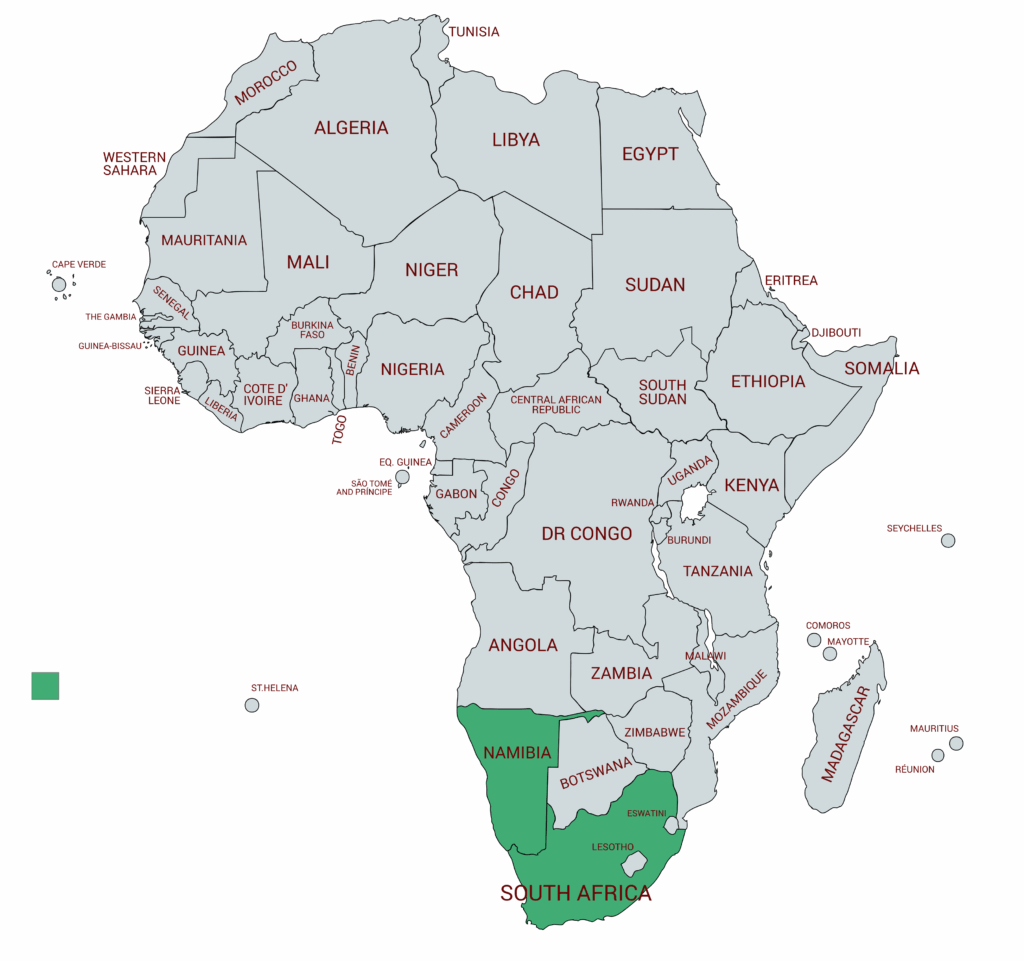
He would point to a map like this, his finger tracing our isolated southern tip. “We were the prize,” he’d say. “But first, the giants had to bleed the land around us.”
“The first thing you must understand,” Mr Petersen might have said, “is that South Africa didn’t just wait. Moscow and Washington kept us waiting.”
While the world saw apartheid as a moral failure, the regime saw itself as a pawn in a superpower game. And like any pawn, it built a shield not for its survival but to keep the game alive: nuclear weapons.
But here’s what few grasp: those bombs were never meant to be dropped.
They were hostage notes to Washington and Moscow.
The six nuclear devices that South Africa developed at Pelindaba with the help of American blueprints and French centrifuges and nurtured by Soviet shadows over Angola weren’t a war strategy; rather, they were a superpower trap. Dubbed the “Strategy of Uncertainty”, it served three brutal purposes:
The answer, for decades, was silence.
This nuclear shield didn’t just protect the regime — it bled Angola and Mozambique dry.
Because as long as Pretoria held that unspoken threat, America signed the cheques and Moscow sent the tanks — all while our liberation waited in the wings.

“And so the red was spilled,” Mr Petersen would murmur, his hand now covering the newly bloodied nations on the map. “Not for ideology, but to build a buffer of fire.”
“While we waited,” he might have added, “Angola and Mozambique bled for Moscow’s ambition and Washington’s fear.”
When Portugal fled in 1975, Moscow rushed Cuban troops to secure its foothold.
Washington funnelled arms to UNITA rebels to push them back. South Africa’s army surged north — not for apartheid, but as America’s proxy.
What followed was Africa’s largest foreign battlefield: 55,000 Cuban soldiers clashing with American-backed SADF tanks in the Angolan savannas. The climax at Cuito Cuanavale (1987–88) wasn’t just a stalemate — it was the moment Moscow and Washington finally saw the cost written in our blood.
In Mozambique, the war was quieter but no less cruel. Washington armed RENAMO to burn schools and hospitals. Moscow sent only advisors—just enough to keep the fire burning, not enough to win.
The difference? Angola was Moscow’s prize. Mozambique was Washington’s distraction.
But both were sacrificed on the altar of superpower rivalry — not ideology, but the cold calculus of giants who never buried a child here.
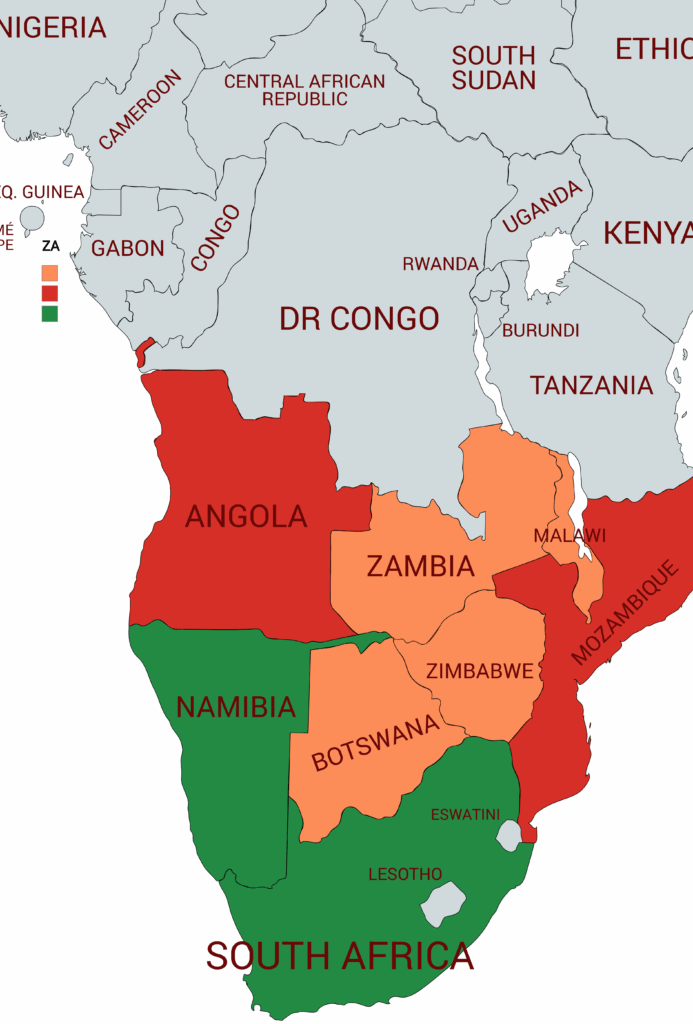
”And so the circle closed,” Mr Petersen would say, his finger tracing the newly highlighted nations. ”The noose was set. And every one of them had to choose: stand with the giants, or stand against them. There was no ground in between.”
“And not everyone agreed on how to survive the giants’ war,” he’d say. “Some chose principle. Others, survival.”
The Front Line States weren’t allies — they were nations trapped between superpower jaws.
Take Zambia. President Kaunda shut his border with Rhodesia, hosted liberation fighters, and bore Washington’s wrath: economic collapse and Rhodesian commandos—armed with CIA rifles—raiding villages at midnight. Kaunda chose a dignified path despite the dangers he faced.
Then there was Malawi. President Banda kept full ties with apartheid South Africa—not out of greed, but because Washington demanded a “stable” corridor for its goods. His people avoided war but lived with a truth: your safety is bought with silence.
Both strategies worked. Both were broken.
And both proved the same terrible lesson: when giants fight, small nations choose which wound to carry.
Until Zimbabwe’s birth in 1980 closed the final gap — leaving South Africa utterly exposed, with nowhere for the superpowers to hide their game.
“And then,” Mr Petersen might have whispered, “the giants stopped playing.”
The long struggle didn’t end with a revolution. It ended the moment Moscow’s empire crumbled in 1991 and Washington finally withdrew its shield.
Overnight, the communist threat — the very ghost that had justified the bombs, the raids, our stolen years — vanished.
South Africa’s nuclear weapons, once America’s insurance policy, became its greatest shame. No U.S. senator could now defend a regime whose only purpose—containing Moscow—had evaporated like desert mist. The bombs were dismantled in secret. The shield lowered. And with nothing left to gain from our suffering, Washington and Moscow shook hands over a map they’d torn apart.
Namibia voted free in 1990. South Africa followed in 1994.
This was not because the world had become kinder, but rather because the game had changed.
Years later, I finally understood.
The development of South Africa’s story wasn’t unintentionally delayed. Moscow’s ambitions, Washington’s ambitions, and a nuclear shield built not for our security but to keep their proxy war raging held it captive.
Mr Petersen knew this. That’s why he didn’t answer right away. He let the world spin. Let me feel its blur. Because some truths can’t be told. They must be circled, again and again, until the moment they land.
And when they do, they reveal this:
Great powers will sacrifice small nations on the altar of their rivalry – until the cost of their game outweighs the prize.
South Africa’s children didn’t wait 40 years for freedom to “mature”. We waited while giants played their war on our soil.
Mr Petersen’s globe is still now. The blur of continents resolved into borders drawn by men who never set foot here.
His finger rested on the southern tip — not as a teacher, but as a witness.
‘They forgot we were human,’ his silence said. ‘Until the game was over.’
And when the world finally stopped spinning for us?
We had to rebuild time itself.